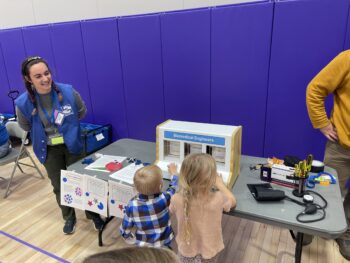
For the past two years, graduate students and faculty from Cornell University’s Meining School of Biomedical Engineering (Cornell BME) have been collaborating with two science museums, the Ithaca Sciencenter (NY) and spectrUM Discovery Area/Museum (MT), on the Bridges to Bioengineering project. This partnership has allowed graduate students, faculty, and museum staff to come together to start co-creating what will be a 1,500 square-foot bilingual (Spanish/English) traveling exhibition. The goal of the exhibit is to teach young learners (6 to 12 year olds) about the applications of biomedical engineering that are improving human health through a hands-on exhibition and supporting interactive activities.
In December 2025, as part of the evaluation, REA conducted interviews with the second cohort of graduate biomedical engineering graduate students that had just completed their exhibit design and prototyping work on the Bridges to Bioengineering project. The interviews captured the graduate student’s motivations, reflections, and overall experiences with being part of the program. Key findings from the evaluation interviews include:
- The Bridges to Bioengineering project required graduate students to rethink how biomedical engineering could be best communicated with non-expert audiences, thus providing a new perspective on science communication through exhibit design prototyping.
- Graduate students enriched their thinking from the more traditional ways of communicating their research (i.e., publications, conference presentations) to engaging with non-scientific audiences through hands-on making, design iteration, and user experiences.
- Museum staff adopted new methods for communicating and displaying complex scientific content to young learners and their families.
Evaluation results thus far have suggested the collaboration between museum exhibit and education staff and graduate students in designing, developing and evaluating this science exhibit is unique and could potentially serve as a model for collaborations between other museums and academic institutions across the country. This project demonstrates the importance of developing informal learning opportunities by embracing different perspectives through shared learning, co-development and collaboration. In addition, it helps to lift the curtain on how exhibits are designed and tested for museum visitors of different age groups.
Click here to read the full evaluation blog.
Bridges to Bioengineering, is funded through the National Institutes of Health’s Science Education Partnership Award (SEPA) program (Award Number: R25EB035479). The content is solely the responsibility of the authors and does not necessarily represent the views of the National Institutes of Health.